Laterna Magika: The Fusion of Live Performance and Projection
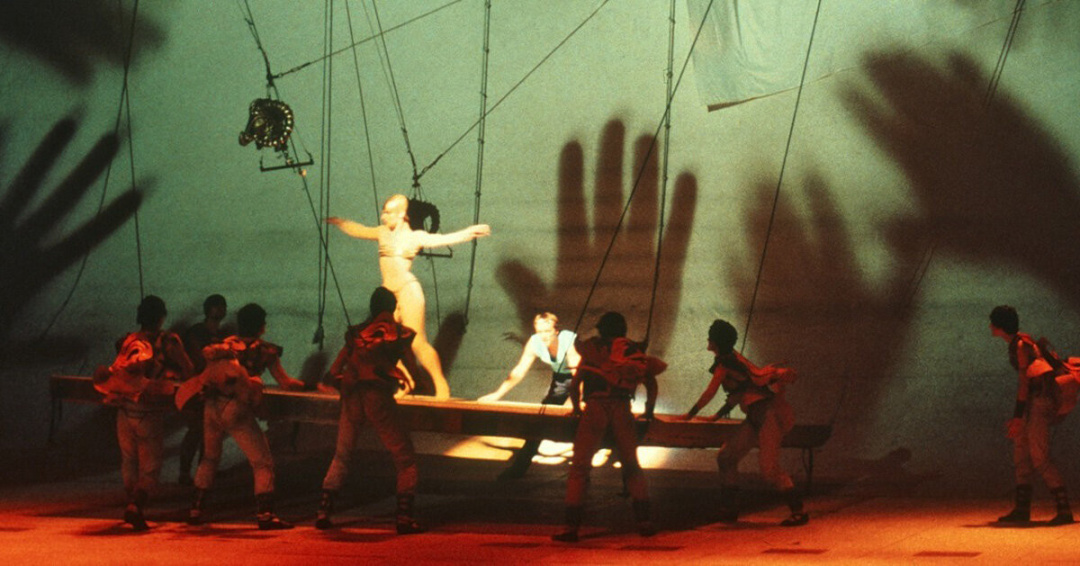
Laterna Magika, conceived by stage director Alfréd Radok and scenographer Josef Svoboda for Czechoslovakia’s pavilion at Expo 58 in Brussels, marked a pivotal moment in theater by merging live performance, film projection, music, dance, and stage technology into a cohesive theatrical language. This innovative project made the relationship between the physical stage and projected images the central focus of its performances, evolving into an independent company of Prague’s National Theatre in 1959. The theatrical language developed by Laterna Magika continues to influence how we think about spectatorship and scenography, particularly in how projected images can reshape our perception of physical space.
The concept that a filmed image could interact with a live performer as if they shared the same world was revolutionary. During the original Expo program, filmed figures appeared to converse with live actresses, while carefully timed projections complemented the live action, music, and dance. This integration allowed the screen to become an active participant in the performance, offering audiences a dual experience of following both the live performers and the projected imagery.
Beyond the Credits
Words from our Sponsor.
Today, as audiences navigate between layers of performance, the relevance of Laterna Magika is increasingly apparent. The integration of screens in various physical environments—from theaters to public spaces—echoes the pioneering work of Svoboda and Radok, who explored the implications of giving projected images a physical role within a performance space. This interplay challenges spectators to consider both the performer and their projected counterpart as integral components of the same scene.
Josef Svoboda, who served as the head of artistic-technical operations at Prague’s National Theatre from the late 1940s, sought to push the boundaries of stage design. His collaboration with Radok at Expo 58 stemmed from a broader ambition to expand the capabilities of scenography. Together, they crafted a dialogue between live action and filmed sequences, where the projected image could enhance or contradict the on-stage action, creating a complex visual language reliant on precise timing and coordination.
The Growth of Laterna Magika's Artistic Vision
Laterna Magika’s evolution into an independent company allowed it to continue exploring these innovative principles. Initially known for revue-like programs, it gradually developed a more extensive repertoire, with productions like Wonderful Circus, which premiered in 1977, showcasing the ongoing relationship between live performers and projected imagery. This dynamic became a defining characteristic of Laterna Magika’s stage language.
Svoboda’s influence on Laterna Magika was profound, especially when he took on the role of artistic director in 1973, guiding the company through a period of transformation. His vision extended beyond individual productions, advocating for the architectural needs of the company, particularly during the development of Prague’s New Stage in the early 1980s. This venue, which opened in 1983, became synonymous with Laterna Magika, providing a permanent home for a theatrical form originally designed for a temporary exhibition.
Worth a Replay
As we reflect on Laterna Magika today, it becomes clear that many contemporary performances grapple with the relationship between physical and projected imagery. The advancements in projection technology, LED screens, and virtual production have made the experiments of Svoboda and Radok feel less like isolated historical moments and more like foundational elements of an ongoing dialogue in theater. The essence of their work—where performers share the stage with images that alter spatial perception—remains a vital part of how we engage with performance art.
Ultimately, Laterna Magika serves as a significant reference point in understanding the evolution of the relationship between image, space, and audience perception. Svoboda’s innovative approach to scenography, which treated the stage as a dynamic environment shaped by light, movement, and technology, continues to resonate in a world where screens are increasingly integrated into our surroundings. This legacy invites us to explore how the interplay of performance and projection can enhance our theatrical experiences.