Celebrating Literary Achievements in AI-Generated Works
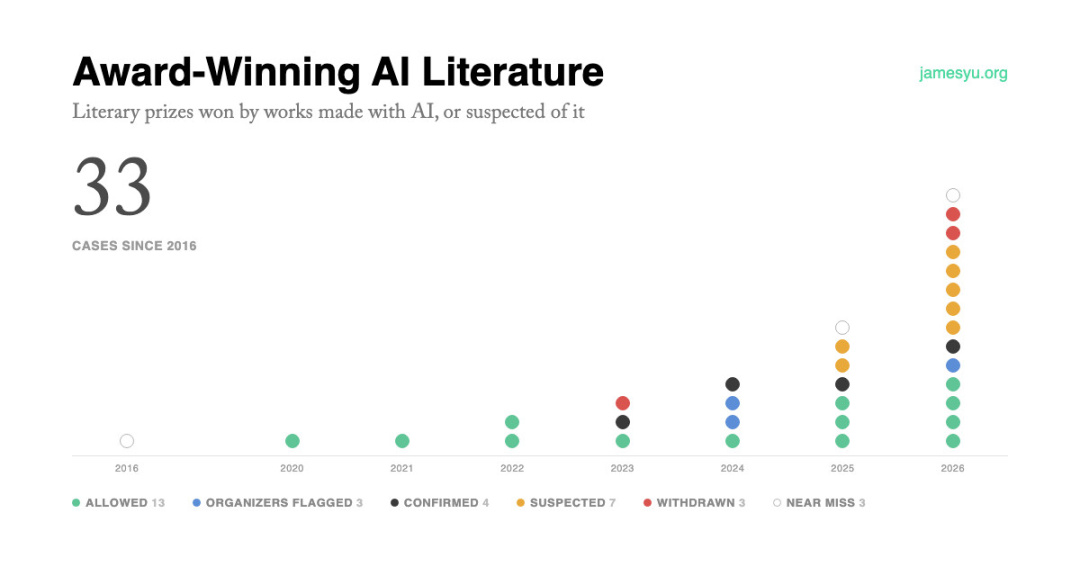
The literary world is experiencing a fascinating evolution, with a growing number of awards recognizing works that have utilized artificial intelligence in their creation process. This trend not only showcases the capabilities of AI in generating creative content but also raises questions about authorship and the future of literature. Here are some notable examples of award-winning AI literature that have made waves in recent years.
In 2022, Kamome Ashizawa's short story "Are You There?" won the 9th Nikkei Hoshi Shinichi Literary Award, receiving the Excellence Award. Ashizawa crafted 101 stories in just three weeks, with the winning piece primarily written by her, supplemented by AI contributions. This marked a significant milestone as it was the first AI-assisted story to win a Hoshi prize.
Beyond the Credits
Words from our Sponsor.
Fast forward to 2025, Toh Katagiri's "The Last Painter" also received an Excellence Award at the 12th Nikkei Hoshi Shinichi Literary Award. The organizers classified it as AI-assisted but did not disclose the specifics of AI's involvement. Interestingly, a fellow finalist mentioned that Katagiri claimed to have personally written every sentence, highlighting the ambiguity surrounding AI's role in creative writing.
The following year, Shamizui's "Genome Tower" was awarded the Grand Prix at the 13th Nikkei Hoshi Shinichi Literary Award. The disclosed use of AI was limited to creating the name of a fictional disease, yet it was still categorized among that year's AI-assisted winners. This illustrates the varying degrees of AI involvement across different works.
En Shijima's "Parallel Self-Mediation Co., Ltd." also received an Excellence Award at the same ceremony. Shijima described the collaboration with AI as more of a choice than a traditional writing process, suggesting a more generative partnership than in other cases. Similarly, Rino Takinouchi's "Erinnerung" showcased a clear narrative of AI-generated prose being extensively rewritten, with ChatGPT providing initial material that Takinouchi refined.
The 13th Hoshi award attracted an impressive 2,107 entries, with organizers noting that 491 of these were considered partly AI-created. Remarkably, three of the four general-division winners had utilized AI in some capacity, further emphasizing the technology's growing acceptance in literary circles.
AI's Global Impact on Literary Innovation
Beyond Japan, the literary landscape is also witnessing AI's influence in various forms. For instance, Karen Ann Donnachie and Andy Simionato's "The Library of Nonhuman Books" won the Robert Coover Award in 2020. This innovative project employed an AI reading machine to generate poetic combinations from physical books, showcasing how technology can enhance creativity.
In Slovakia, Liza Gennart's poetry collection "Výsledky vzniku" won the Zlatá vlna award in 2021. This collection was the result of training GPT-2 on over 2,000 Slovak works, which were then curated and lightly edited by Gennart. Such initiatives highlight the intersection of technology and traditional literary practices.
The impact of AI on literature is not limited to awards; it also raises broader questions about creativity, authorship, and the future of storytelling. As AI continues to evolve, the literary community will likely see even more innovative works that challenge conventional notions of authorship and creativity.
The Final Take
As we look ahead, the dialogue surrounding AI's role in literature will only intensify. The recognition of AI-assisted works in prestigious awards signifies a shift in how we perceive creativity and the tools that facilitate it. Writers and readers alike will need to navigate this new landscape, considering the implications of AI on the writing process and the authenticity of literary expression.
In conclusion, the increasing acknowledgment of AI in literary awards reflects a significant cultural moment. It challenges traditional boundaries of authorship and creativity, paving the way for a future where human and machine collaboration is not only accepted but celebrated. As these trends continue to unfold, the literary world stands on the brink of a new era, one where the fusion of technology and creativity will redefine storytelling as we know it.