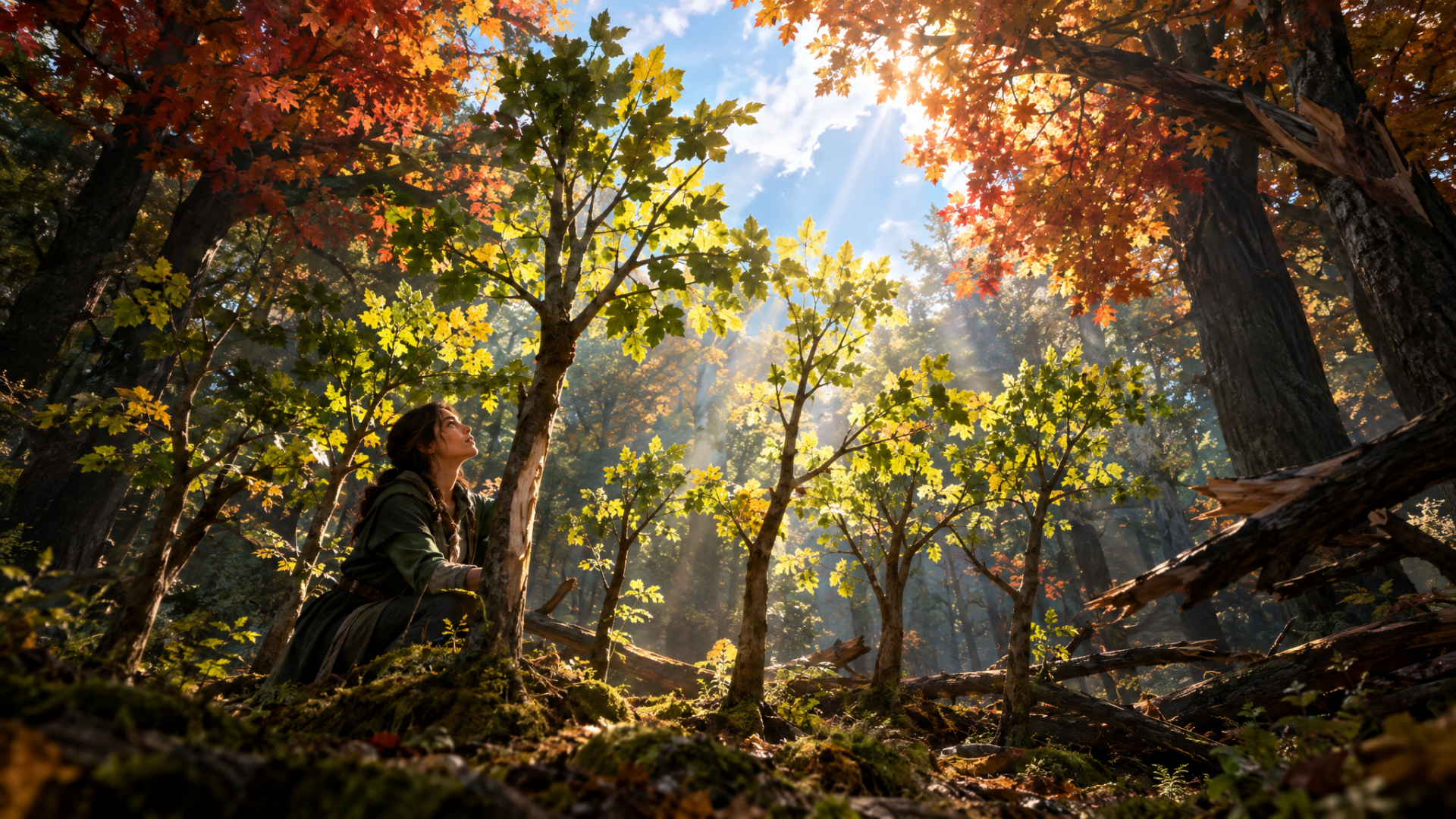
By late summer, the eastern grove had become a roof. Maples lifted red and gold leaves in broad layers until the morning sun reached the moss only in thin, scattered coins. Beneath them, the oaks stood dark and quiet, their branches angled upward like hands waiting for an answer.
Mara, a young oak with a pale scar along her trunk, had spent three seasons reaching toward a break in the canopy. Each spring she pushed out new branches. Each summer a maple limb slid across the light. Her newest shoot had turned brown before its first acorn formed.
“You are growing in the wrong direction,” said Elder Venn, the oldest oak. His trunk was hollow on one side, and wrens nested in the opening. “Roots endure what leaves cannot. We have always endured.”
Mara looked toward the ridge, where a white birch stood in full sun. “The birch does not endure,” she said. “It grows.”
That autumn, a storm tore down three maple limbs and opened a bright gap above the grove. For two days, sunlight poured through. The oaks stirred. Their leaves warmed, and hidden buds began to swell. Then the Maple Assembly arrived, led by Cressa, a silver-barked tree whose crown covered half the eastern slope.
“The fallen limbs are a danger,” Cressa announced. “Until they are cleared and the canopy restored, no tree may extend into the opening. The upper air belongs to the trees best suited to govern it.”
“Who decided that?” Mara asked.
“The Assembly,” Cressa replied. Her leaves clicked together. “The Assembly decided that.”
The rule had been written after an old drought, when the maples claimed their dense leaves had protected the soil from heat. In exchange, every tree was promised creek water and shelter from the northern wind. But the creek had shifted years ago, and the maples had kept the sky. No oak remembered voting. Everyone remembered the punishment: branches that rose too high were stripped by appointed woodpeckers enforcing “balance.”
That night Mara went from trunk to trunk. Some oaks feared losing what little protection remained. Others whispered that a broken law was still a law. Elder Venn listened from his hollow. “If you challenge them,” he said, “the maples may close the creek path.”
“If I do nothing, we close it ourselves,” Mara answered. “Our young trees are dying before they learn the shape of shade.”
At dawn, Mara made her choice. She did not tear through the maple canopy. Instead, she called the smallest trees to the storm gap and asked them to bend together. They raised their branches in a living ladder, each sharing the strain with the next. Their leaves filled the opening not with one crown, but with a shifting window that moved as the day moved.
The Maple Assembly sent woodpeckers. The birds hammered at the first branch until it split. Two saplings fell, and the forest floor shuddered beneath them. Yet their roots remained linked by old fungal threads. The surviving trees held the ladder. Sunlight touched the exposed roots, the moss, and seedlings that had never seen noon.
Cressa called Mara a trespasser. Mara answered by inviting every tree to count the dead saplings at the next Assembly. Some maples came, carrying leaves browned at the edges. Their lower branches had begun to starve too; the crowded canopy shaded itself.
For the first time, the Assembly met on the forest floor instead of in the highest branches. The maples demanded that the gap be closed. The oaks demanded a new rule. A birch proposed that no tree should control more sky than its roots could support. An ash asked who would measure such a thing. A young maple, hardly taller than Mara, said sunlight should be measured where it landed.
The debate lasted until moonrise. In the end, the old law was narrowed and made answerable to the trees it governed. Each spring, the canopy would open in three places. No branch could be cut without a gathering. The creek path would belong to every root, and the Assembly would rotate among the species.
Years later, Mara’s crown reached above the maples. It did not eclipse them. Wind moved through their leaves in separate rhythms, carrying acorns, winged seeds, and red samaras across the same clearing. Elder Venn, nearly empty now, sheltered a family of wrens. When he asked whether the forest had found peace, Mara watched a shaft of sunlight cross the moss. “No,” she said. “It has found a way to keep speaking.”
Inspired by “The Trees” — Rush.