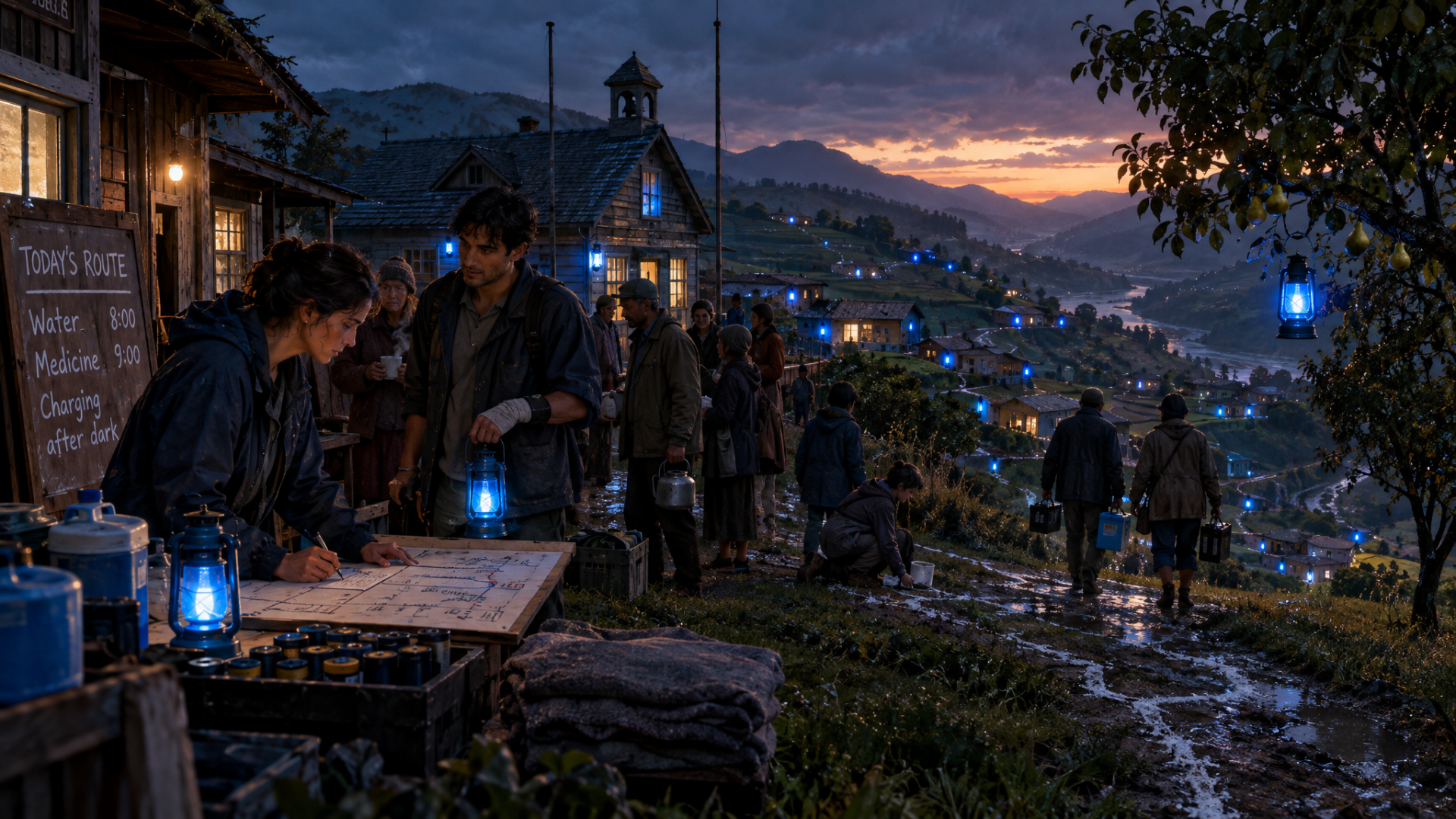
Before sunrise, Nella unlocked the storage shed beside the old quarry and chalked the day’s route on plywood: water at eight, medicine at nine, battery charging after dark. She wrote in large letters because people had begun borrowing glasses, and because clear instructions looked more dependable than she felt.
A week of rain had folded the road into the valley. No one was hurt, but the bus stop, telephone cable, and shop entrance disappeared beneath mud. Engineers said repairs might take three months. Nella translated this for everyone as, “We’ll get through the next three weeks first.”
People came to her for keys, blankets, charging space, and advice. Two brothers needed to know whether their father’s oxygen machine could run from the solar bank. Pere brought a cracked kettle. Nella answered each question, marked each request, and smiled. She had become the hinge on which the settlement swung.
Arun Vale was usually waiting near the shed. He had moved into the schoolhouse with his mother after their basement filled with mud. His wrist was braced from an old injury, so Nella gave him lighter work: sorting batteries, labeling water cans, counting blankets. He carried a blue enamel lantern even in daylight.
“You’re not on the lifting list,” Nella told him one afternoon.
“I’m being useful at a lower altitude,” Arun replied.
His joke made people laugh without making their troubles smaller. Nella also noticed how carefully he avoided the schoolhouse windows. His mother had begun asking strangers for directions to a house that no longer stood, and Arun slept in a chair outside her classroom so she would not wake alone.
Nella kept the schedules and keys in a metal box beneath her cot. She kept her own fear nowhere. Her father’s farm sat below the break in the hillside, and whenever rain struck the roof, she imagined the earth moving again. If she admitted she was frightened, she believed everyone would hear it in the change of her voice.
On the fifteenth day, the charging bank failed. Clouds had swallowed the sun, and the batteries dropped below the level needed for the oxygen machines. Nella told the gathered families that a repair crew would come in the morning. She did not mention that the crew had already canceled twice, or that she had been awake calculating which machines could run in turns.
Arun watched her hands. “You can stop making your voice sound like a roof,” he said.
Nella wanted to be angry. Instead, she sat on the edge of a desk. “My farm may be gone,” she said. “I’ve been pretending that knowing everyone else’s schedule means I have a future scheduled too.”
No one hurried to reassure her. Mrs. Olan set down tea. One brother took the route board from Nella’s lap. Then Arun opened his blue lantern. He had replaced its dead wick with reflective tape and a hand-cranked bulb.
“These can signal from the ridge,” he said. “Every house with power hangs one. The next house knows where to send a charge, a blanket, or a person.”
By dusk, twenty-three lanterns shone across the terraces, with gaps where roofs had shifted and one bright light swinging from a pear tree. Neighbors carried batteries by hand. Children marked safe paths with flour. Nella stayed at the schoolhouse desk, but others leaned over the board beside her, recording what each household could offer and what it needed.
The road remained closed for three months. Each evening, the lanterns came on, even in homes with nothing to send. Their glow meant that need had not vanished; it had moved. No one had to be the strong one every night.
When the road finally reopened, Nella walked to the first bus with Arun. Her farm had been declared unsafe, and she had nowhere to return to. She expected the news to split her open. Arun handed her the lantern.
“You’ll need this,” he said.
Nella turned it in her hands. “The line is coming down.”
“Of course,” Arun said. “Temporary things do. We can still know how to build it again.”
Inspired by “Lean on Me” — Bill Withers.