Under the Coppercap Mountain stood the city of Brindle, where every citizen had whiskers, a winter coat, and an opinion about valves. The city’s warmth came from a buried furnace called Old Auntie, which breathed through iron pipes into the streets. The upper districts received a steady, buttery heat. In the lower galleries, where the pipes had rusted thin, residents slept in mittens and thawed their soup by holding the bowls against their noses.
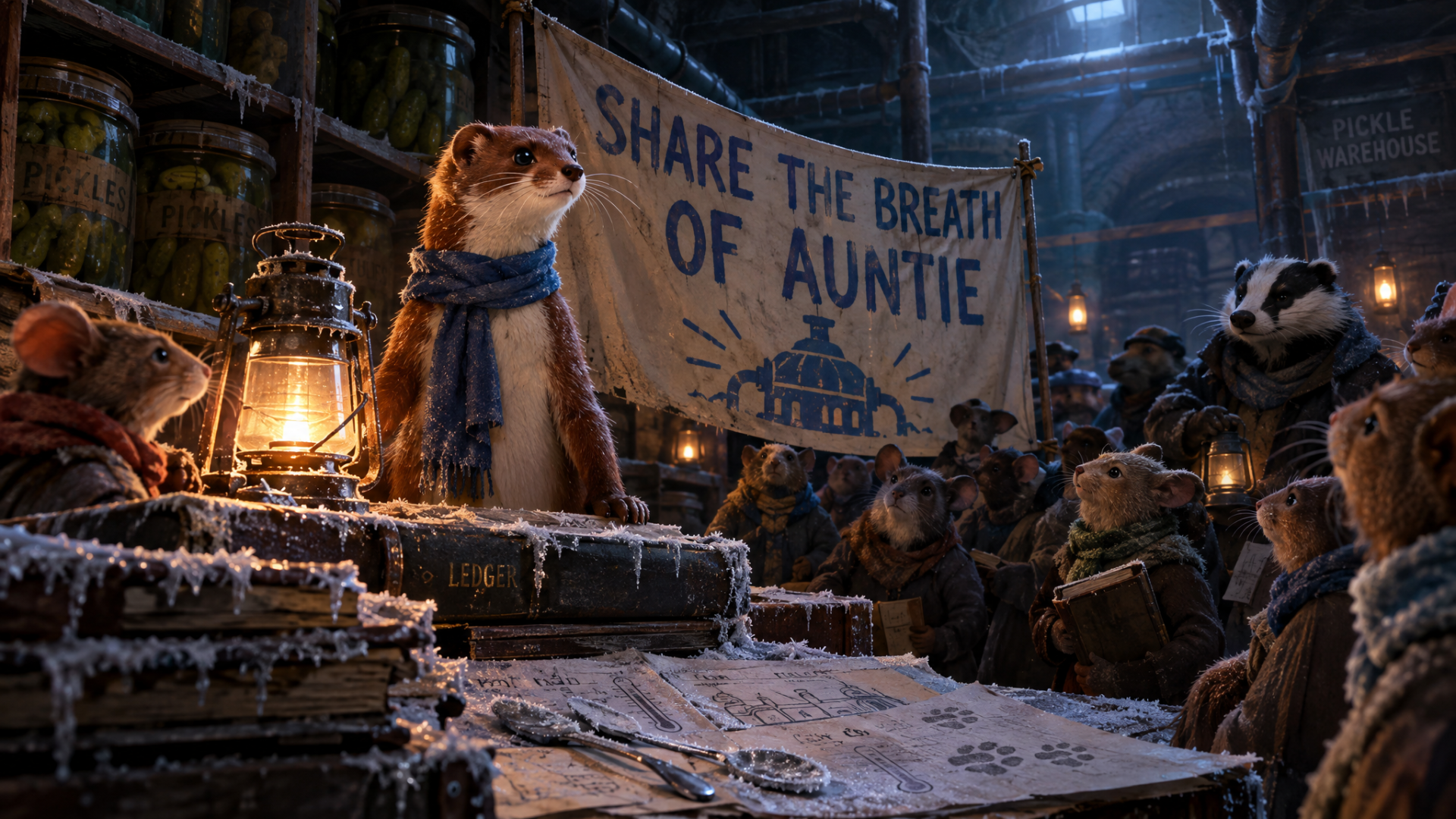
Mara Quill, a young stoat with a blue scarf and a talent for repairing cracked thermometers, lived below Pipe Nine. She wanted the Council to send heat downward before her little brother’s paws turned permanently white. Her petition was not unreasonable. It contained figures, sketches, three frozen teaspoons, and the pawprints of 184 residents.
The petition was returned with a note from the upper district: PLEASE DO NOT DISTURB THE BALANCE OF THE CITY.
“What balance?” Mara asked at the public fountain. “You have seven warm streets and we have one lukewarm drain.”
A plump marmot named Dobbins, who lived beside the furnace’s main gate, dabbed his whiskers with a linen square. “Warmth rises,” he said. “That is its nature. Besides, our families have always slept close to the pipes.”
“Your families also own the pipe keys,” Mara said.
Dobbins looked surprised, as though she had accused him of owning the moon. “Naturally. Someone must keep them somewhere.”
The lower galleries began meeting in the old pickle warehouse. Mice brought ledgers. Badgers brought lanterns. A family of shrews brought a banner reading SHARE THE BREATH OF AUNTIE. They organized night walks, carried their petitions through the upper streets, and tied blue scarves to every valve they could reach. At first the upper residents laughed. They invited the marchers inside for cocoa, then locked the doors when the marchers asked to inspect the radiators.
Soon the meetings grew sharper. A baker in the lower quarter refused to deliver rolls upstairs until the city opened two additional vents. A troop of young voles occupied the Warmth Exchange and sat on the lever that redirected fuel. When the watch arrived, the voles passed the lever from paw to paw, chanting, “No one sleeps cold alone.” By dawn, Old Auntie was coughing soot, three ovens had cracked, and the upper streets smelled of burnt flour.
The Council summoned Mara because she was the only marcher who could read a gauge. Its chair, Magistrate Pell, was a tall heron in a silver waistcoat. He listened to both sides while taking notes on a napkin.
“The grievance is genuine,” Pell announced. “The arrangement is unequal. Therefore, beginning tomorrow, all districts shall receive precisely the same temperature.”
Mara felt a small lift of hope. “You’ll replace the narrow pipes?”
“Much simpler,” said Pell. “We shall fit every home with a governor.”
The governors arrived in black crates. Each was a little brass box that opened a roof vent whenever a room rose above forty-one degrees and slammed it shut whenever the room fell below that number. The devices were praised as impartial. They did not care whether a citizen was a marmot, a mouse, or a shrew.
For one bright hour, the gauges across Brindle pointed to the same mark. Then the upper homes began venting heat into the tunnels, while the lower homes, unable to reach the furnace’s pressure, received only cold air through their obedient governors. The brass boxes clicked and clicked, making the city sound like a thousand teeth.
Dobbins’s rose bushes blackened in their window boxes. Mara’s brother stopped shivering because he stopped moving his paws. In the pickle warehouse, the banner sagged with frost. Down in the furnace chamber, Old Auntie’s fire weakened beneath the governors’ constant corrections, and her iron heart gave a soft, enormous crack.
Magistrate Pell called the result “a transitional inconvenience.” The upper residents demanded their old heat back. The lower residents demanded the governors removed. No one could agree who should touch the valves now, so the Council sealed them all behind a new wall.
By spring, Brindle had one temperature, measured officially at forty-one degrees. The city’s clocks stopped, the pipes ceased humming, and every citizen wore the same expression: puzzled, pale, and waiting. Mara kept her blue scarf wrapped around her brother’s paws. From behind the wall came a faint tapping, as if Old Auntie were trying to remember which way was up. No one had yet decided whether to answer.
Inspired by “The Trees” — Rush.